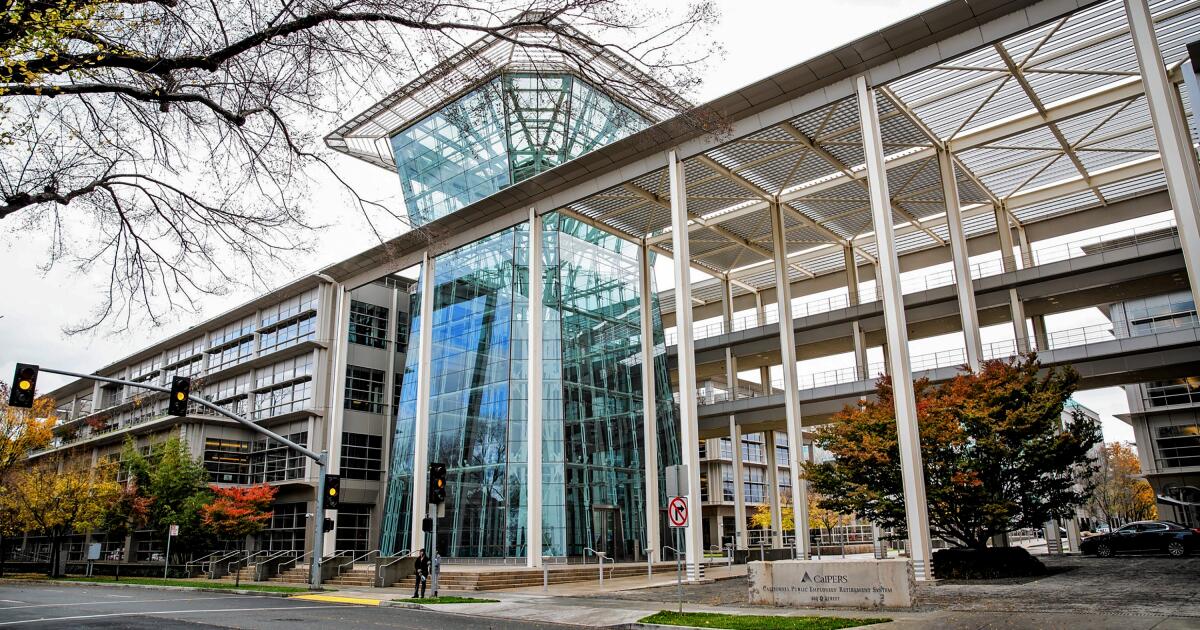
California’s two largest pension funds invested more than $2.7 billion with companies that contract with Immigration and Customs Enforcement or the Department of Homeland Security, a new analysis shows.
CalPERS, a nationwide megafund for public employees, has invested about $1.6 billion in technology firm Palantir, weapons manufacturers General Dynamics and L3Harris, and telecommunications companies AT&T and CACI, according to an analysis by non-profit advocacy and research group Stand.earth released on Thursday.
CalSTRS, which supports public school teacher pensions, has invested $1.1 billion in these companies.
The largest pension fund contributions were to Palantir, with CalPERS investing $734 million and CalSTRS investing $625 million.
The data included in the analysis were taken from quarterly filings with the US Securities and Exchange Commission through December 2025.
Richard Brooks, who leads research at stand.earth that focuses on the financial sector, pointed out the apparent inconsistency when teachers in California, a sanctuary state, saw firsthand that the state’s aggressive immigration crackdown is destroying student families as their retirement funds grow.
He said: “There should be a balance between where the money is invested and the types of values that the people of the government accept.” “People’s hard-earned money will help ICE separate families. It’s too bad that two of California’s largest pensions have chosen to ignore this.”
Palantir has been providing data analysis software for federal immigration enforcement for years, and earlier this year signed a new $1 billion procurement agreement with the Department of Homeland Security.
CalPERS spokesman James Scullary said the pension fund does not deal with individual assets, but takes “environmental, community and governance issues.”
“When issues are identified, we work to analyze the situation, gather relevant information and seek solutions,” Scullary said.
CalPERS, with assets of more than $550 billion, is the largest pension fund in the US, with investments earning returns of 11.6% last fiscal year.
Both CalPERS and CalSTRS have stated that investment portfolios seek to minimize risk and maximize return.
CalSTRS spokeswoman Barbara Zumwalt said the fund takes a “long-term view of investing to manage opportunities and risks around the world.”
“Everything we do at CalSTRS is rooted in our mission to secure the financial future of California’s current and retired teachers,” Zumwalt said.
According to the CalSTRS website, approximately 10% of a California teacher’s annual compensation is invested in the CalSTRS pension fund.
For two years a group of teachers in Los Angeles, San Diego, Berkeley and other places in California called CalSTRS Divest has been forcing the pension fund to leave its assets Palantir together with other companies involved in the Israeli war supported by the US in Gaza, such as the aviation and defense company Lockheed Martin, the heavy machinery company Caterpillar El Systems and the weapons manufacturer.
Andrea Pritchett, 62, a middle school teacher in Berkeley involved in the group said Palantir is an important site “because the dangers it poses to outsiders are also related to dangers. [the company has] it has been tormenting people inside this country.”
Members of CalSTRS Divest say such investments run counter to the fund’s stated policies, which consider whether a company or industry is making a product that is extremely dangerous to human health. But, Pritchett said there has been little movement from CalSTRS so far.
Pritchett said: “Their response was that their fiduciary responsibility outweighed any imagination.
Two California pension funds have also refused to divest from fossil fuel companies. Both CalPERS and CalSTRS are disclosed sustainable investment strategies increasing assets in low-carbon assets and other climate solutions in the past few years, but continue to invest in international oil giants such as ExxonMobil and Chevron.
In 2024, the California Legislature considered a bill that would force CalPERS and CalSTRS to divest from fossil fuel companies by 2031. But it faced some pressure and the bill’s author, Lena Gonzalez (D-Long Beach), ended up withdrawing the proposal with plans to reintroduce it later.
Gonzalez said in a statement Thursday that pension fund investments in ICE contractors are “very concerned” and that employees “should not rely on outside research to understand where their pension money is going.”
“We must demand transparency and accountability, especially when billions are invested in contracts that threaten the safety and dignity of Californians,” Gonzalez said.
Combined, the 30 US public pensions have more than $8.8 billion invested in ICE contracts that include private prison companies Core Civic and Geo Group, according to a Stand.earth analysis. The New York State Common Retirement Fund, the New York State Teachers’ Retirement System and the Florida State Board of Administration are among those that made donations.
Stand.earth researchers also analyzed bank statements and found that eight of America’s top banks — including JPMorgan Chase, Bank of America, Wells Fargo and Citi — gave more than $72 billion in loans to ICE contractors as of 2020.
Wells Fargo said that the bank’s analysis of the company’s financial statements such as mortgages was flawed, because the audit calculations included commitments to the credit facilities. With line of credit, banks offer pre-approved annual loans that can be used regularly or partially.
The other banks did not respond to requests for comment.
#California #reserve #public #pensions #invest #companies #work #ICE