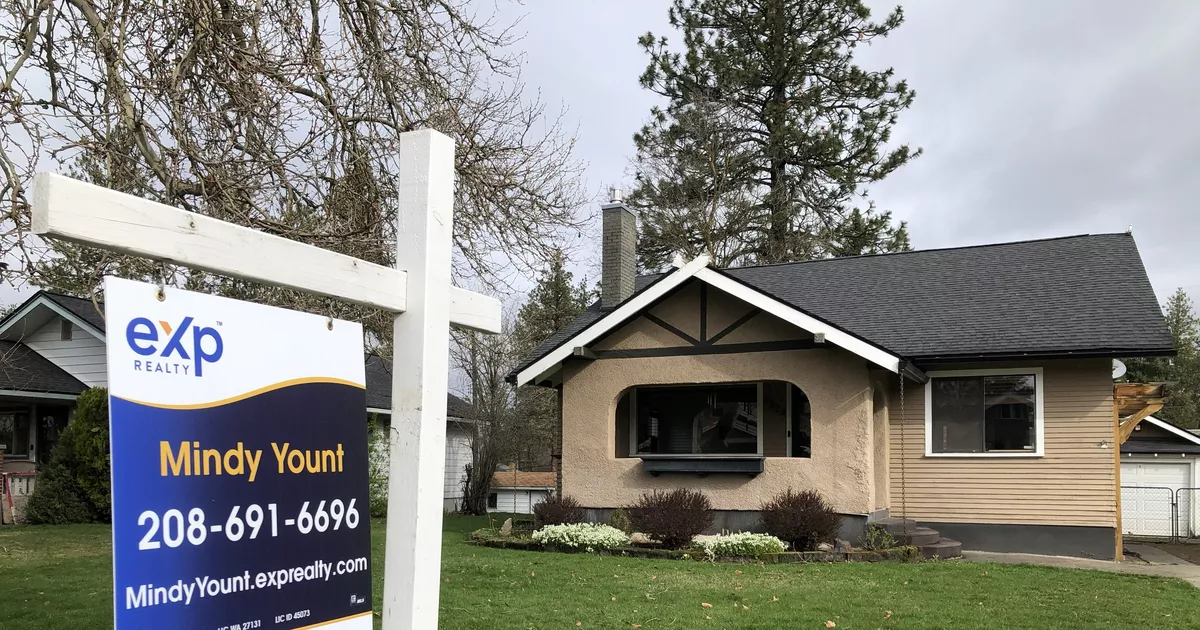
Buds appearing on tree trunks and green grass on Lilac City lawns mark the start of spring when Realtors begin their rush to sell homes.
This year’s peak home listing season was starting to show great promise. Up until 30 days ago, mortgage rates and interest rates had dropped below 6%, the economy appeared to be slowing down, and housing inventories began to rise.
But war broke out when the US and Israel attacked Iran, which responded by closing the Strait of Hormuz. Gas prices began to rise, as did interest rates and economic uncertainty.
“The Iran conflict is putting pressure on homebuyers from multiple angles, as higher interest rates reduce purchasing power and higher oil prices lower consumer confidence and reduce budgets,” said Danielle Hale, Realtor.com chief economist.
.
The average 30-year, fixed rate hit 6.46% on Thursday, according to mortgage finance giant Freddie Mac. That’s up from 6.38% last week and marks five straight weeks of gains after rates fell below 6%.
The war has also pushed up oil prices, which are up more than 50% since the end of February. The average price of gasoline in the country reached $ 4.08 a gallon on Thursday, according to data from AAA, which is about 37% higher since the US and Israeli planes began to attack Iran.
“As long as the conflict is a threat to the price of oil, the markets will continue to buy high inflation risks, which will translate into high credit ratings,” Eugenio Alemán, chief economist at investment bank Raymond James, wrote in an email to the New York Times.
As a result, the number of homes on the market is increasing because they are not selling quickly, said Hale, who posted his comments on social media on March 27.
“Mortgage is still lower than it was last year,” he said. “But home buyers have had to restructure their finances in the past few weeks, and this may cause an erosion of housing sales over the next few months.”
While Hale noted data showing a good home selling season set this week for Seattle, Tom Hormel, a realtor with RE/MAX of Spokane, said the rush of home sales started early in Spokane after a winter with little snow.
“Everybody in my office that I’ve talked to says the spring market started in mid-February and it’s not slowing down,” Hormel said. “If you buy it right, it sells fast, and if you buy it wrong, it just sits there.
Michael Wendland, past president of Coeur d’Alene Regional Realtors, said he received five phone calls last week from Western Washington home buyers looking to escape the new tax on incomes over $1 million that Gov. Bob Ferguson signed into law last week.
“We’re going to see a huge flow from there,” he said.
But like his counterparts in Spokane, Wendland said the local market is ready to flex its muscles until more economic conditions arrive.
“March 15 rolls around, and we get one week of 55 to 60 degrees and the Inland Northwest starts going crazy,” he said. “Everyone was very happy the last 30 days.”
Then interest and mortgage rates rose in late March.
He said: “There is no doubt that it caused a little damage to the market.
Consumer market
While home prices are still at historic highs, and even more so in Kootenai County, the days of a seller’s market with homes generating high cash offers due to list prices are over.
Suzy Dix, a Windermere Manito broker, said she had a buyer last year who wanted to list a house for about $1.2 million. He waited.
“He said, ‘It must be about $1.4 million now,'” Dix said. I said, ‘No. That’s 1.2 million dollars. People sell them.
According to data from Spokane Realtors, the median home price in the Spokane area in February was $403,998, which was down 2% from the $412,375 median price in 2025.
Hormel, who previously sat on the board of directors for the National Association of Realtors, said people trying to analyze the market should not put too much stock in the lower median price.
“A drop in price doesn’t mean the market is going down,” he said. “It just means the seller has missed their price mark, because people won’t overpay if they have a choice.”
And those options keep coming.
Wendland, of Coeur d’Alene, said his listing area, which includes several nearby counties, has about 1,300 units for sale.
“Right after COVID, we had 179. So, the average market would have about 2,000 units,” he said. “The sellers of their expensive goods are not selling. If they want to sell, they have to lower their prices.”
The latest data from Spokane showed that February listings are up 25% over 2025. With so many homes for buyers to choose from, sellers must make sure they stand out.
Dix told the story of a realtor who was reluctant to fix several issues that needed attention on a house he wanted to list.
“Today’s buyer doesn’t want to buy a fixer-upper. They want to buy it in perfect condition,” he said.
Hormel agrees, saying sellers must sell their homes at a price that exceeds “the competition.”
“There is a difference between a competitive price and a coercive price,” he said.
For example, if a seller lists a home for $415,000 that is compared to 10 other listings at the same price, it qualifies as a “competitive” price.
“But you need to make it where the customer comes in and says, ‘There’s a good value that I can’t pass up,'” Hormel said. “You need a heavy price.”
Gone are the days when consumers were immersed in their homes and retailers could ignore cosmetic issues, he said.
“If all the houses are listed for $415,000 and you have new granite countertops and floors, you’re pushing against the competition,” he said.
Hormel continued: “You can’t sell your home like other homes in your neighborhood if your home isn’t up to par with the competition.” The market calls you that.
#sellers #market #buyers #Spokane #Coeur #dAlene #home #sales #entering #fast #phase #economy #turns